

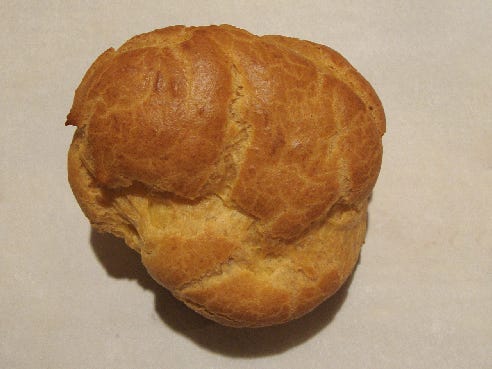
How to Make a Paste that Puffs?
Pâte à choux, perhaps the most versatile of all pastry doughs, puffs up because of the air you beat into it.
Here’s another baking miracle that performs its magic due to air alone—choux paste or pâte à choux. It translates literally as “the pastry for making little cabbages." Cream puffs are, hands down, the most well-known choux paste descendant. You make the dough by beating flour into boiling water and butter to make a paste—called a panade in French—and cooking the paste over heat while stirring vigorously to drive off excess moisture. Finally, you beat in eggs a little at a time off heat. And that’s it.
The first time I made it I couldn’t imagine how this warm dense yellow blob—perhaps the most versatile of any pastry—could be transformed into crisp shells for cream puffs, éclairs, and profiteroles, or how spoonfuls rolling around in hot fat would puff up into tender/chewy beignets. And if I mixed some cheese into the paste and baked mounds of it, they’d transform into custardy French puffs of gougères. Why does choux paste puff? Because of the air you beat into the eggs—which expands with heat—and the wetness of the dough--the water gets converted to steam--making for even more puff.
The only equipment you’ll need to make choux paste is a heavy saucepan to cook the panade and a sturdy wooden spoon for beating in the eggs. A food processor or heavy-duty stand mixer can do the work for you, but if you’ve not made pâte à choux before, I recommend the elbow grease approach to give you the feel of what it’s all about.
Tips for a Paste that Puffs
There is no strict proportion of the four major ingredients—water, butter, flour, and eggs—when making pâte à choux. Much depends on the moisture content of the flour, how you measure it, the volume of eggs and even how you measure the water! I’ve made it with 1 cup water (8 ounces), 6 tablespoons butter (3 ounces), 1 cup unbleached all-purpose flour (5 ounces), and 4 large eggs (7 to 7.5 ounces out of the shells), which makes puffs that grow to great heights with crisp shells and tender insides.
For the liquid, many more recent pâte à choux recipes use water, milk, or a combination, vary the amount of butter, call for bread flour instead of all-purpose flour, and combine whole eggs with extra egg whites. All will affect the size and texture of the puffs. It really depends on what you want to do with the choux paste.
The following formula, a favorite of Shirley Corriher’s, and a variation of one in her seminal work, Bakewise, makes especially crispy puffs because egg whites are great drying agents, bread flour (higher in gluten than all-purpose flour) absorbs more liquid than all-purpose flour—allowing you to add more eggs—and the added gluten also helps give a higher rise:
1 cup water (8 ounces), 4 tablespoons butter (2 ounces), 1 cup bread flour (5 ounces), 3 to 4 large eggs plus 2 large egg whites (7.25 to 9 ounces out of the shell). You decide how much egg to add depending on the final texture of the pâte à choux: the pastry should just hold its shape on the spoon with an inch or more of the dough hanging down 2 or 3 inches (see 7th photo in preparation description below).
Ultimately, the proportions you decide to use will depend on what you’ll be making. Gougères, which have a definite custardy texture, are best with the first formula, but you might prefer the second one for cream puffs and éclairs, which should be really crisp.
Me? I’ve been happily making cream puffs, éclairs, beignets, and other classic French desserts such as Paris Brest and Gateau St. Honoré as well as savory cheese puffs (Gougères), gnocchi, and canapé toppings with the first formula, simply adjusting flavors by adding ½ teaspoon salt to the boiling water and butter for non-sweet recipes and adding 1 tablespoon sugar and a big pinch of salt for sweets.