

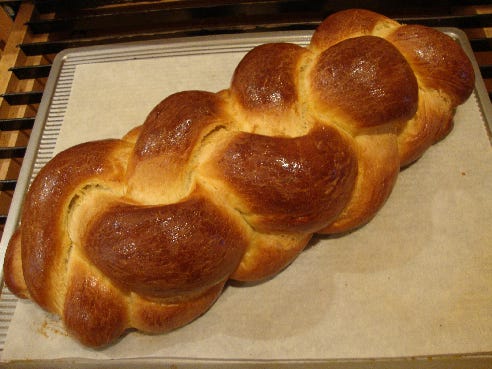
This braided loaf, golden and tender from eggs and oil, is steeped in tradition and symbolism. To set it apart from the ordinary weekday loaf of whole wheat bread, it is made with white flour, sugar or honey for sweetness, and oil and eggs to symbolize richness of spirit. Traditionally, challah was baked on Friday, in advance of the admonition that Saturday be a day of rest where no work of any kind was allowed.
Today it is baked and eaten any day of the week. The term challah means “portion,” and biblical law directed that a small piece of dough or bread be set aside as a gift for the Jewish rabbis, who had no income of their own. This recipe makes a large, spectacular, 4-braided loaf.
You begin by making a “sponge,” a mixture of flour, yeast, and water, that results in the production of more yeast cells and begins the development of the bread’s flavor. The resulting bread is moist and tender and is delicious plain or spread with butter. Challah makes excellent sandwiches, toast, and when a day or two old, sensational French toast.
Follow the step-by-step photos for the braiding. Here’s an excellent video clearly illustrating how to braid a 4-stranded challah. When I discovered the YouTube video, I’d pause it after every move, rush into the kitchen across the hall from my study, perform the maneuver I’d just seen, and repeat going to my computer, then the kitchen, until I’d shaped the loaf. http://www.youtube.com/watch?v=4RvoqkYaUWo.
Note on measuring flour: Dip dry measuring cup into flour container, fill the cup to overflowing, and sweep off the excess with a straight edge to level the contents of the cup. Don’t shake or bang the cup. One cup of flour measured this way weighs 5 ounces (140 grams).