

On a recent trip to Italy, courtesy of the Italian Trade Agency, I was introduced to the wonderful world of Italian olive oils and their many uses in cooking and eating. The point of the trip was to learn how to taste and evaluate extra-virgin olive oils from all over Italy. The Ercole Olivario, an annual competition that identifies and honors the best producers of Italian olive oil, is a big deal.
Olive Oil Competition!
Over 270 olive oils had been entered, and by the time we six American journalists arrived in Rome, the field had been narrowed down to 100 finalists. Eleven of the finalist oils came from Lazio, the region where Rome is located. At the offices of the Rome Chamber of Commerce, we were given 5 of the 11 oils to sample. We began with the fruitiest and lightest olive oil, slightly peppery and bitter, excellent for salads and for baking and progressed to the heaviest, more spicy than bitter, and ideal for drizzling onto a cooked steak.
How to Properly Taste Olive Oil
For the tasting, I cradled a plastic cup with olive oil in one hand and covered the cup with the other hand. After gently moving my hands in a circle for 15 seconds or so to warm the oil, I uncovered the oil, plunged my noise close to the oil’s surface, and inhaled deeply. What hit me first was a decidedly fruity aroma, maybe a bit grassy. After sipping the oil and inhaling through closed teeth to aerate it (making creepy gurgly sounds), I swallowed. Then the magic happened. My taste buds were jostled with spiciness and bitterness. Sometimes both at once and other times one dominated and the other took presence backstage.
I wanted to own all five oils, and I knew that if I had tasted all of the remaining finalists I would have wanted to own them all too. Such is the allure of a great extra-virgin Italian olive oil.
For the Ercole Olivario, sixteen expert tasters were isolated from one another as they judged the submitted oils in blue glasses. Blue hides color so the taster cannot be influenced by it. The final awards were presented in Perugia, a lovely hillside town about a 2 1/4 hour drive north of Rome. One of the winning oils came from Abruzzo, a region in Italy’s mid-calf, just west of Lazio and reaching the Adriatic coast. The oil came in 2nd in the “Medium Fruity” category. We all tasted this extraordinary oil and found its fruitiness, pungency, spiciness and bitterness extremely well balanced.
How to Identify a Quality Olive Oil
But what can you, as a cook, do to assure you’re buying a quality extra-virgin olive oil? You can’t just open bottles in a store and taste them. What you must do is study the label. If you see the letters DOP or PDO those are “designation of origin” notations and identifies an oil that originates in a specific region in Italy. What this means ultimately is that the quality or characteristics of the oil are due to factors inherent to a particular geographic setting. It also means that production of the oil takes place entirely in a defined geographic area. These are not mass produced oils and they command a hefty price because making them is labor intensive.
What if there are no DOP or PDO letters on the label? Note that the Abruzzo oil doesn’t have the DOP designation. Look for a location the oil came from or the name of the producer. This information is on the above label. Sometimes the specific variety of olive is named. There are more than 500 in Italy. Some bottles might say “Olio d’oliva di categoria superiore ottenuto direttamente dalle olive e unicamente mediante procedimenti meccanici.” In English this means: “Superior category olive oil obtained directly from olives and solely by mechanical means.” It may seem foolish to say that the oil came directly from olives, but there have been cases of olive oil fraud where seed oils have been doctored to look like olive oils. Remember that olive oil is a fruit juice and so look on the bottle for a harvest date. If you’re buying olive oil in 2016 there should be a harvest date of 2015 on the label. Acidity of extra-virgin olive oil should not exceed 0.5%. But some excellent extra-virgin oils may not provide acidity content. In general I stay away from big brand labels.
I’ve been baking cakes and cookies with olive oil for many years. Extra-virgin olive oil works particularly well in citrus-flavored cakes, and I wondered what would happen if I added it to a chocolate cake. Well, it works great! The recipe I decided on is extremely simple and comes from A is for Apple, a cookbook my wife and I co-authored. You whisk all the dry ingredients in one big bowl, the liquids in another, stir them together to make a smooth batter, and bake.
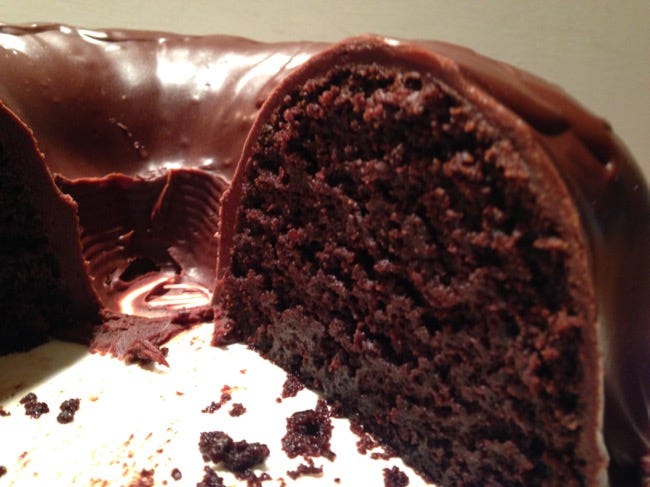
The chocolate sour cream glaze is thick and shiny and cloaks the cake beautifully.
Here are some step by step photos to guide you.
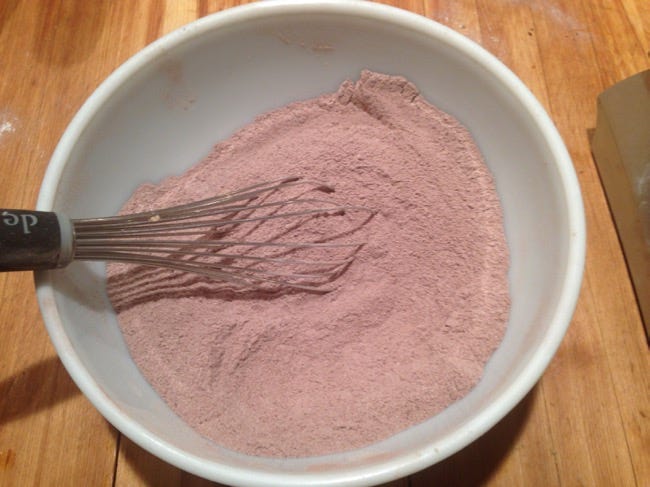
Dry ingredients all combined in a large bowl.
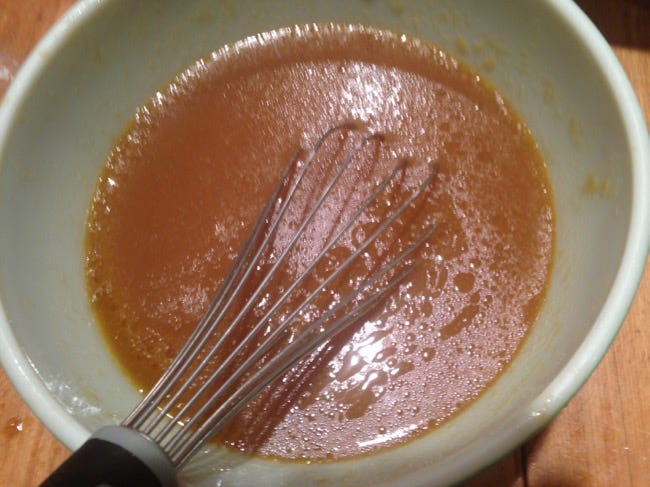
Liquid ingredients whisked until creamy.
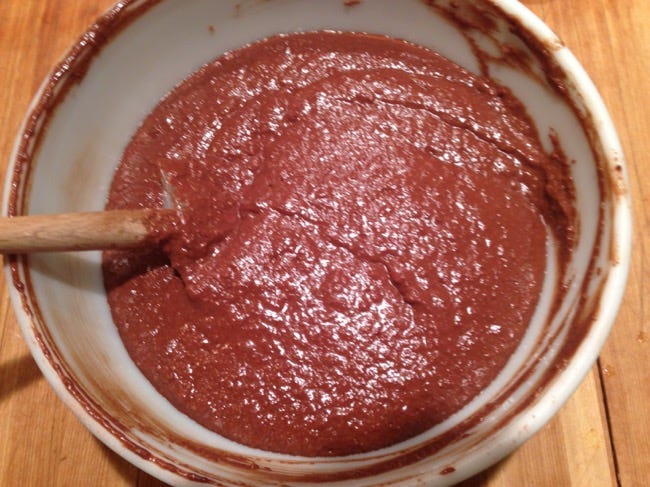
Batter mixed and ready to bake.
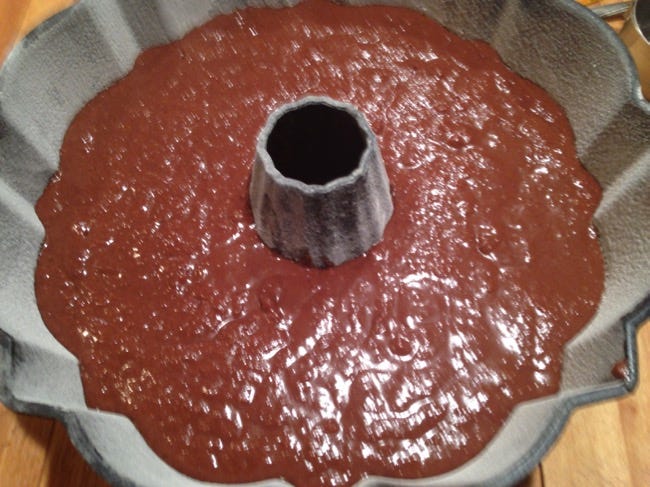
Batter in Bundt pan ready to bake.
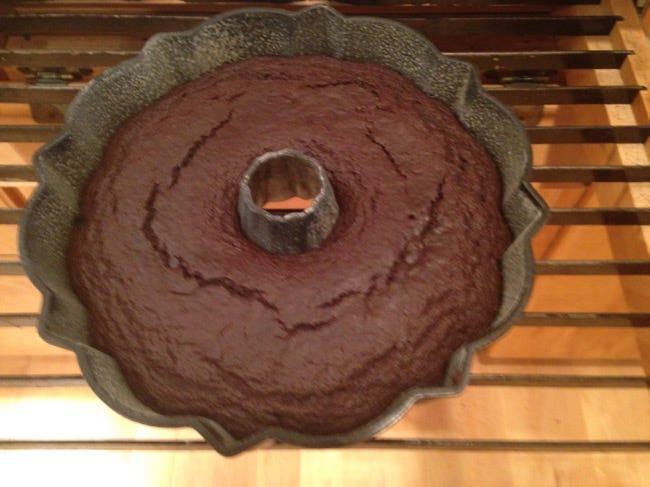
Baked Cake. Note a nice round crack on top.
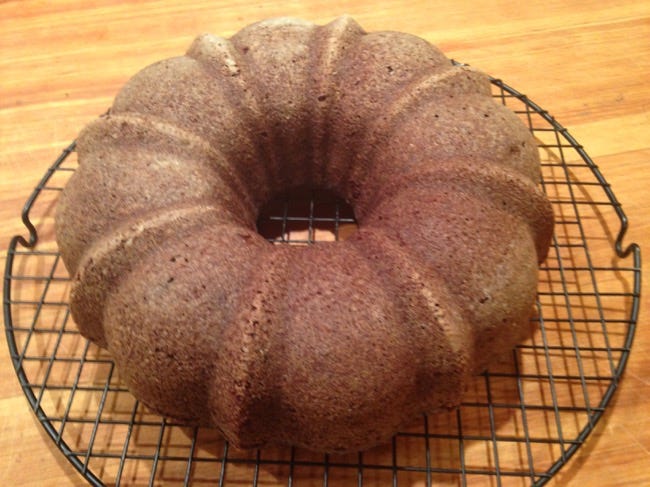
Baked cake inverted onto a cooling rack to cool completely.
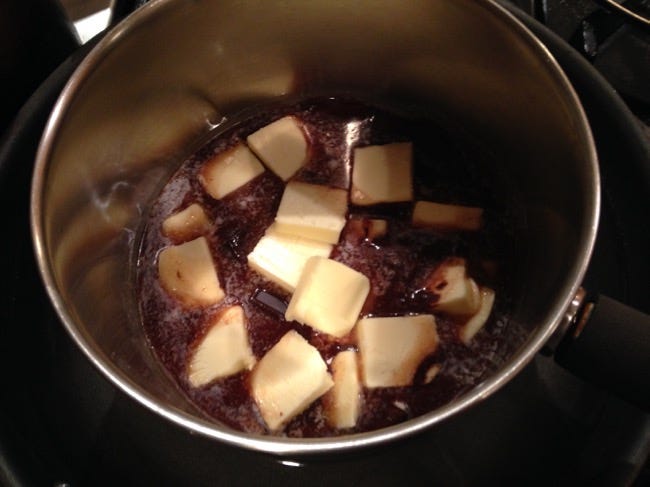
Chocolate and butter for the glaze melting in a saucepan set into a pan of very hot water.
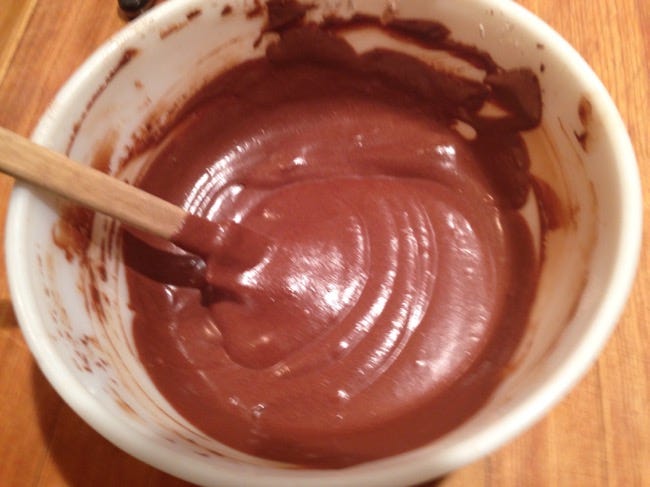
Thick and shiny glaze ready to pour over the cake.
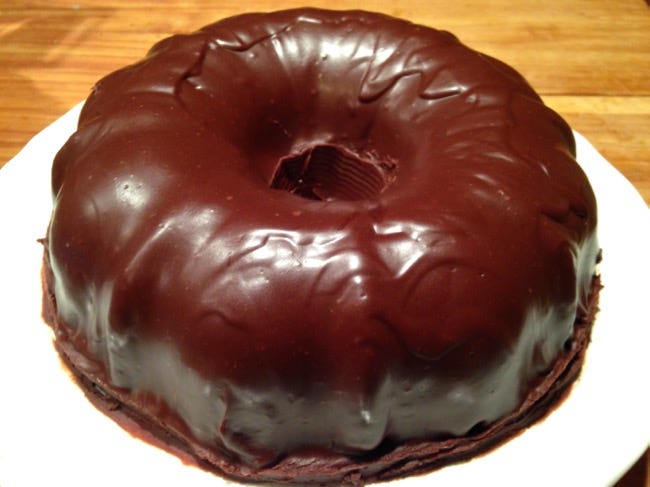
The glazed cake set on a cake plate.
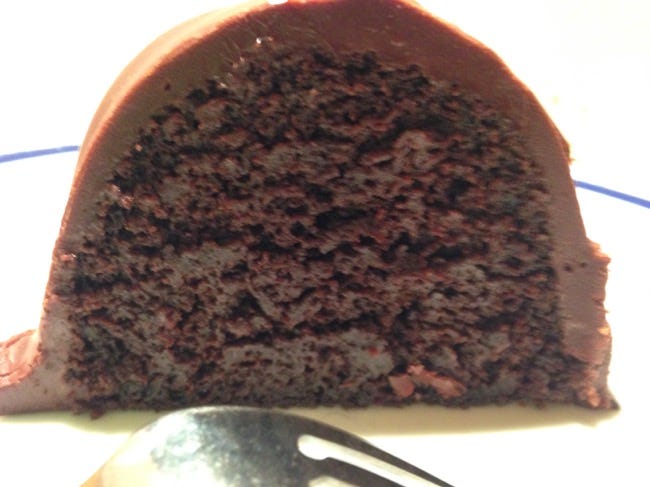
A slice of the fudge cake showing moist texture and thick coating of glaze.
A peek into the cut cake showing the fudgy texture and thick glaze coating.
Now you’re ready to bake!