

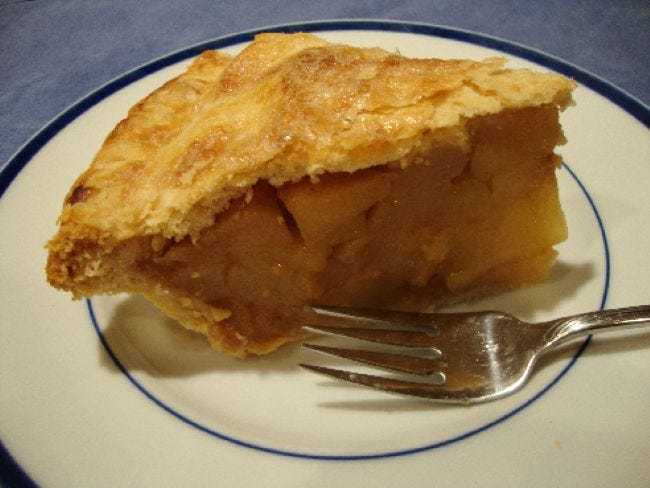
I like lots of apples in my pie, about 5 pounds worth, and I’ve found that by partially cooking the apples first in butter with sugar and spices, the apple flavor becomes concentrated, the apples reduce in volume, allowing me to pack a huge amount of flavor into a pie–and I don’t need to use any flour or cornstarch as a thickener. Another bonus, the apples will be tender. No crunchy apples for me, please.
Actually, making apple pie this way goes all the way back to 1796, when Amelia Simmons described the technique for all sorts of fruit pies in American Cookery, the first cookbook written by an American and published in America.
A bonus with this method is that the reduced water content results in leftovers that keep fresh for up to 5 days in the refrigerator. A quick reheating in a moderate oven restores a just-baked quality to the pie.
What Variety of Apples are Best for Apple Pie?
When making apple pie, I like to use a combination of 3 or more kinds. The apples should all hold their shape when cooked, and they should be a mixture of tart and sweet fruit.
With more than 7,000 known varieties of apples in the world, and from one to two dozen available at farmers’ markets and in supermarkets, it can be a daunting task to know which apples to select.
Fortunately, four major categories have recently come into use to identify apples’ taste and texture profiles: Firm-tart apples (Granny Smith, Idared, Goldrush, Rome); Firm-sweet (Braeburn, Cameo, Honeycrisp, Jazz, Pink Lady); Tender-tart (Cortland, Empire, Jonathan); and Tender-sweet (Fuji, Gala). I’ve listed only a few examples under each profile, but knowledgeable vendors at farmers’ markets and in supermarket produce departments should be able to answer all sorts of questions for you regarding what sort of apple is best for a particular recipe.
For pies, I like a combination of one-half firm-tart apples, one quarter firm-sweet, and one-quarter tender-sweet fruit. All apple types within these categories hold their shape in cooking. Just a hint of vanilla added after cooking heightens sweetness.
Oh, the pastry for this pie is tender and flaky and crisp and foolproof. For best results, weigh your ingredients and do not handle the dough to excess. And if you want to substitute whole wheat pastry flour for the unbleached all-purpose flour and cake flour (2 1/4 cups total), it’ll work just fine.
Please let me know how you like this pie, and if you have any variety of apple you particularly favor I’d love to hear from you.