

I am very new to gluten-free baking, and it’s not because I’ve developed a sensitivity or intolerance to gluten. I am a baker, and I have been asked to teach a class on gluten-free baking at Rancho La Puerta next month (April, 2012). So in the past few weeks I’ve plunged head first into this bewildering and enormous area of possibility. And a whole new world has opened up for the baking wizard. But where would I begin? My first source of information came from Gluten-Free Baking Classics by Annalise G. Roberts (Revised and Expanded Second edition, Surrey Books, Chicago, 2008). In this book, I found a basic gluten-free brown rice flour mix that works in most baked goods except for breads (the author provides two different formulas for those).
What Are Some Gluten-Free Option for Baking?
Venturing on, I discovered web sites devoted to gluten-free cooking and baking (Gluten Free Girl is excellent) that called for flours made from almonds, hazelnuts, amaranth, millet, garbanzos, fava beans, tapioca, sorghum, white rice, quinoa, buckwheat, corn, and teff, and starches produced from tapioca, potato, arrowroot and corn. And these were just a start. Because gluten-free flours and starches lack, well, gluten, xanthan or guar gums must be added to certain recipes to help the baked goods set properly and give them the expected texture. Update: This February, after running since 2005, the GlutenFreeGirl.com website has shut down. You can read about it in this article in Last Call. Thank you for all the recipes and information that inspired so many!
I bought all of these products, turned my kitchen into a baking laboratory, and began experimenting with various blends. I also found Bob’s Red Mill Gluten-Free All Purpose Baking Mix, made with garbanzo bean flour, potato starch, tapioca flour, white sorghum flour, and fava bean flour. Would that work just as well as the blends suggested by the many gluten-free web sites? The answer to that question is it depends. Many of these flours have physical and chemical properties and taste profiles that we are only just beginning to figure out. Gluten-free baking is really in its infancy, and it will take a lot of fiddling and finagling by dedicated bakers to come up with recipes that aren’t just gluten-free versions of gluten-containing recipes, but recipes that are unique because they’re gluten-free. This is what gluten-free baking should be about.
Using a Scale for Measuring Baking Ingredients
One thing I’ve come to appreciate about gluten-free flours and starches is that they’re all of different densities, which means that for best results you’ll need to weigh them! The exclamation point means that perhaps the gluten-free movement will finally rid us of cumbersome cups and that all kitchens will be equipped with a scale. I can only hope. If you don’t have a scale, put your measuring cups for dry ingredients on a sheet of waxed paper and spoon the flour or starch into them to overflowing, then sweep off excess. Starches, in particular, compact readily and are dense, and they like to stick to cups and spoons, so fluff them up with a fork before measuring.
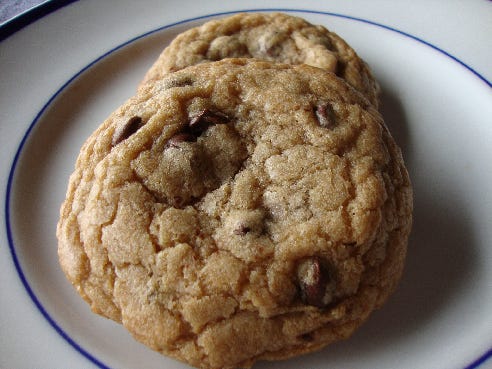
Here is one recipe from my Rancho La Puerta gluten-free baking class, Chocolate Chip Cookies. These are huge (I like my cookies big) and they’re easy to mix up, easy to bake, and they taste great. Note that my recipe uses only ½ teaspoon baking soda. This amount is just right. Too many chocolate chip cookie recipes use too much baking soda, causing the cookies to spread out and become thin instead of staying on the thickish side and having a nice chew.
Be sure to mix the dough a day or so before baking and refrigerate it. The sugars take time to dissolve completely and the caramel flavor from the brown sugar needs time to develop. The brown rice flour mix formula is from Gluten-Free Baking Classics. Even the Land O’Lakes web site uses it in many of their recipes. Crunchy Texture Option Good as these cookies are, they left a powdery feeling in my mouth. I decided to see if baking the dough until the cookies were crunchy—the original Toll-House method—would correct this problem.
After shaping the cookie dough into balls, I flattened them to a thickness of between ¼ and ½ inch. A 2-ounce ball of dough, when flattened, will measure a bit more than 3 inches in diameter. I spaced the flattened dough 1- to 2-inches apart on a cookie sheet and baked them at 375 degrees for 13 to 15 minutes, until they were browned all the way through. When cool, the cookies were deliciously crunchy. That did the trick. No one would ever know these cookies are gluten-free. I am happy to make these anytime. No apologies necessary.