

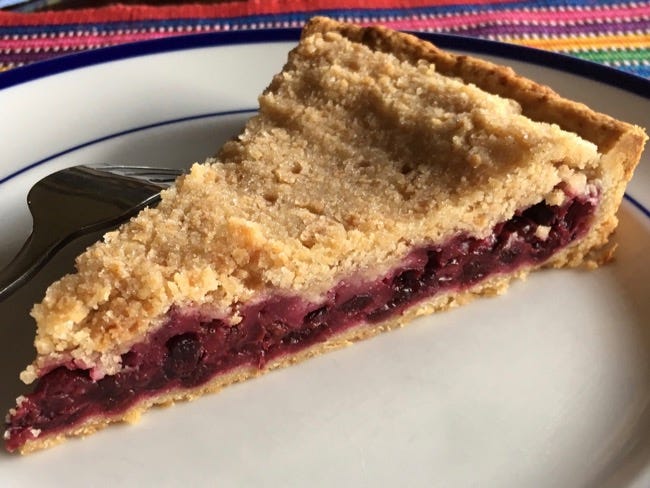
The food processor makes great pastry. The speed of processing insures ice water and butter maintain their chill. The fat stays solid and the dough rolls out like a dream. For the filling, beaten egg whites coat the huckleberries with a protein film to ke
What to Make with Huckleberries?
Let me just say that I am wild about this tart, and you'll be too. What is it? A thin, crisp buttery pastry, a layer of tart huckleberries, and a cinnamon-scented crumb topping. Every year, between early-to-mid July and stretching to the end of August or even into the first week or so of September, I go crazy with Montana huckleberries. I make huckleberry pies, muffins, ice cream, jam, and tarts, and also a few sauces to serve with roasted quail and game birds. And this tart!
Now you must be wondering:"Where can I find huckleberries if I don't live in Montana?" Huckleberries grow in coastal Oregon, Washington, northern California, and in the mountains of Idaho. Maine wild blueberries are very similar to huckleberries and they are often available frozen in some supermarkets. If not, ask your produce manager if it's possible to order them. Huckleberries and blueberries are related, but huckleberries only grow wild. Here's the good news: You can make this tart with blueberries! I tell you how at the end of the recipe.
Now onto basics. The easiest and best way to make pastry is with a food processor. I've developed a foolproof method that will give you a crisp, flaky pastry every time. If you have pastry-phobia, I hope to banish it by guiding you through every step. The generous huckleberry filling--berries only, no sugar--is held together with beaten egg whites only. The egg white proteins envelop the berries and during baking they form a protective coating that helps to hold in the berry juices. The crunchy topping contains the sugar and adds the necessary sweetness.
I think this tart is great served all by itself. It’s pretty as a picture and tastes even better than it looks. What more could you want?
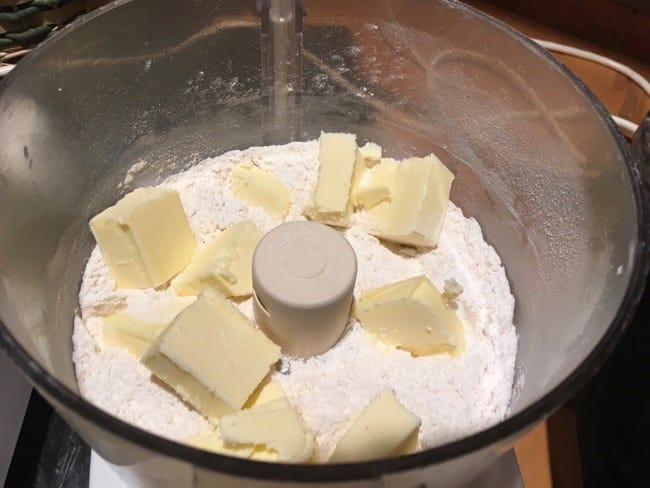
So here we are at the beginning. The all-purpose and cake flour are in the processor work bowl along with the salt and sugar and the cold butter pieces are on top. I use a combo of all-purpose and cake flour to approximate the gluten content of pastry flour, which has less gluten than all-purpose flour. If you don't have cake flour, don't worry. Just use all all-purpose flour. The pastry will be fine. We're now ready for the first step in making pastry: breaking up the butter into smaller pieces.
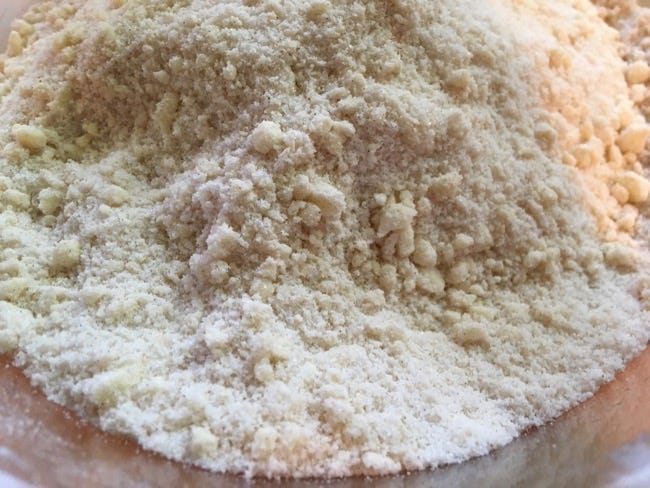
Once all your dry pastry ingredients are in the processor work bowl, turn the machine on and off (pulsing) four or five times for 1 second each to cut the butter into coarse pieces. Some recipes say the particles are pea-sized or resemble coarse meal. What you'll wind up with is a range of sizes of the butter pieces. The largest bits of butter will be about 1/4-inch in size. If some are larger. Fine. What's really important is that the pastry ingredients are cold. The next step is to add the liquid: Egg yolk, ice water, and cider vinegar. Just mix them all together in a 1-cup glass measure with a pouring spout and we'll move on to the next step. Oh, the vinegar just acts as a little insurance to slow down gluten development. You won't taste it in the finished tart.
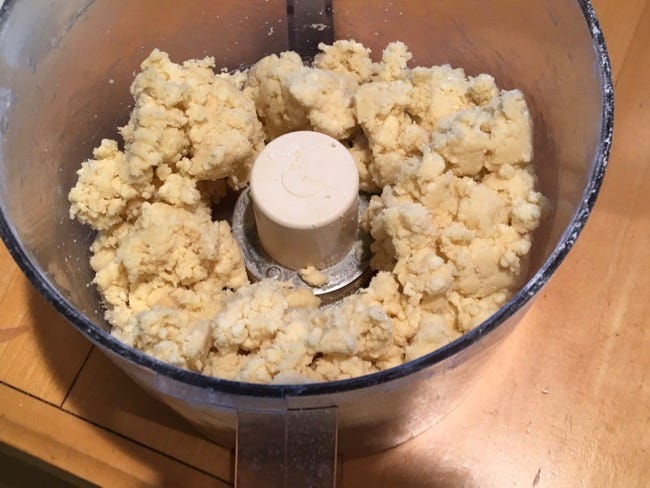
This picture shows the completed pastry. I know it looks like a mess of lumps, but that is as it should be. When making pie or tart dough in the food processor you want to keep those pieces of butter about the same size when everything was dry. How to do that? You have to do two things at the same time: Add the liquid slowly while pulsing very rapidly. Start adding the liquid in a steady stream and at the same time pulse continuously for fractions of a second as you add the rest of the liquid. It's a rat-a-tat-tat-tat-tat feeling. By the time all the liquid's added--in about 10 seconds or so--you've pulsed the machine about 30 times. In that 10 seconds, the very rapid pulsing moistened the dry ingredients thoroughly but kept those butter pieces pretty much intact by tossing everything around in the work bowl so quickly there wasn't time to cut the fat any smaller.
Now dump the contents of the work bowl onto a smooth counter top lightly dusted with flour and press all the lumps together to form one mass. Shape the dough into a disk about 4-inches in diameter. Work quickly to keep everything cold. Wrap the dough in plastic, and refrigerate for at least 1 hour to allow the gluten to relax and the butter to harden.
The recipe tells you to roll the dough into a 14-inch circle about 1/8-inch-thick, and to fit it into the tart pan without stretching the dough. As you roll you'll see pieces of butter. When flattened and baked, they make the pastry flaky. Once the dough has been draped over the tart mold, lift the edges of the pastry and push it gently into the pan so that it hugs the bottom and the sides. You'll have extra pastry hanging over the edge of the pan. Use scissors to trim the excess dough leaving about 1/2-inch of overhang.
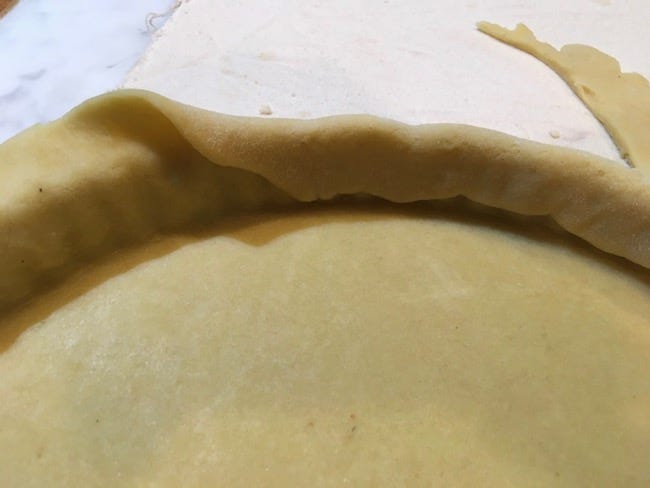
Fold the overhanging pastry inward and press it onto the pastry lining the side of the tart pan to make a double thickness of dough.
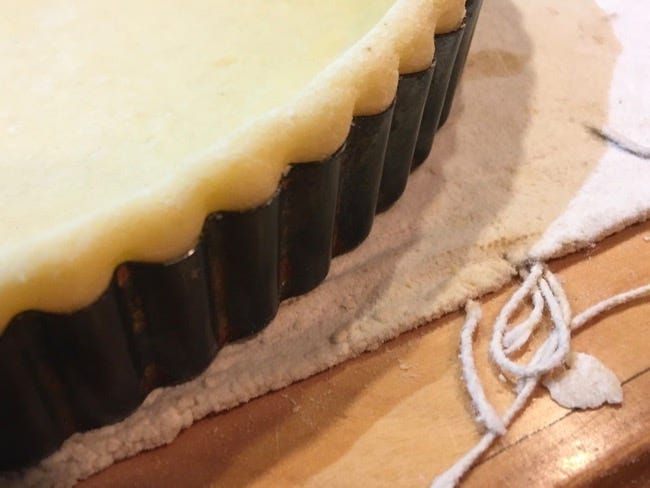
Press on the sides of the pastry to raise it about 1/4-inch above the rim of the tart pan. You'll need this extra height to contain the huckleberries and crumb topping. Refrigerate to relax the dough for 30 to 40 minutes or longer. The pastry shell can be chilled overnight. When thoroughly cold, wrap in plastic to keep it from drying out. Make the crumb topping and whip the egg whites.
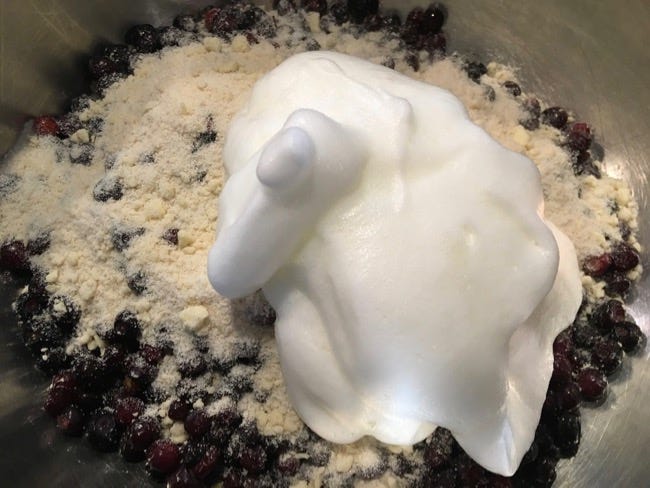
For the filling, put the huckleberries, 1/2 cup of the crumb topping (streusel), and whipped egg whites into a large bowl and fold them together to combine well. The whites and streusel insure the huckleberries will stay put when the tart is served.
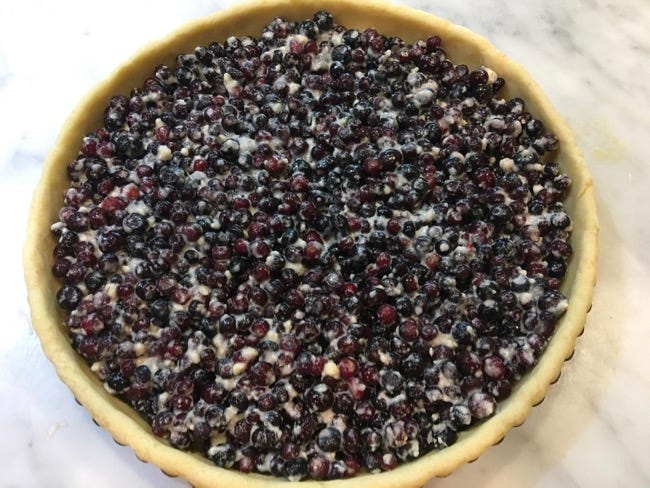
Here's the huckleberry filling in the tart shell. You can see that the shell is extra tall to hold the crumb topping.
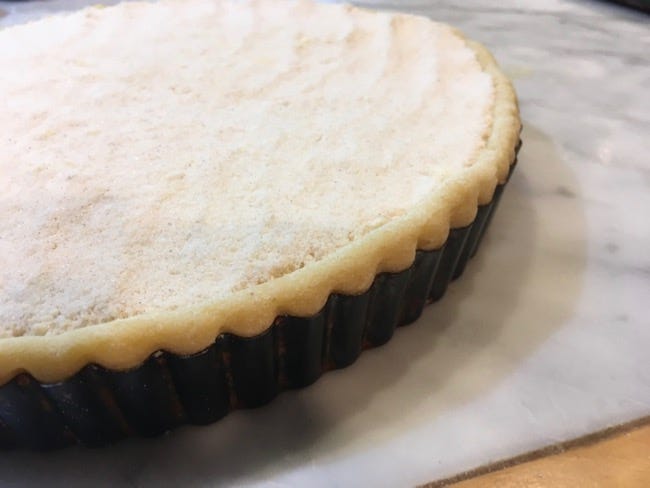
And here's the tart ready to bake. The streusel or crumb topping pretty much fills the shell.
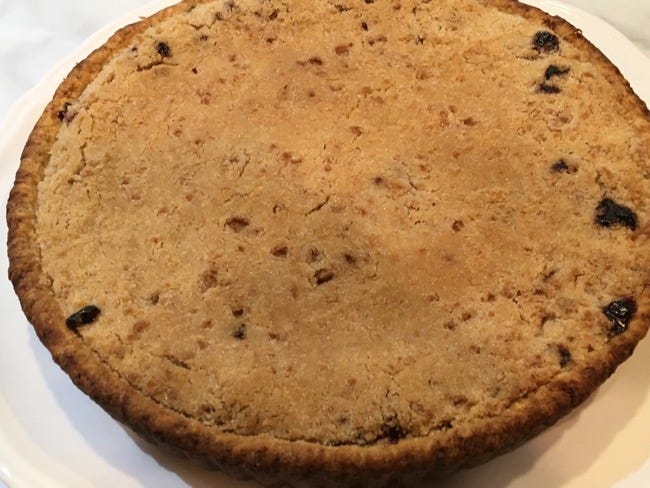
The baked tart ready to serve. The pastry is browned, crisp, and flaky. The crumb topping is crunchy. This tart is great as it is.
Just for the heck of it, here' what wild Montana wild huckleberries look like.
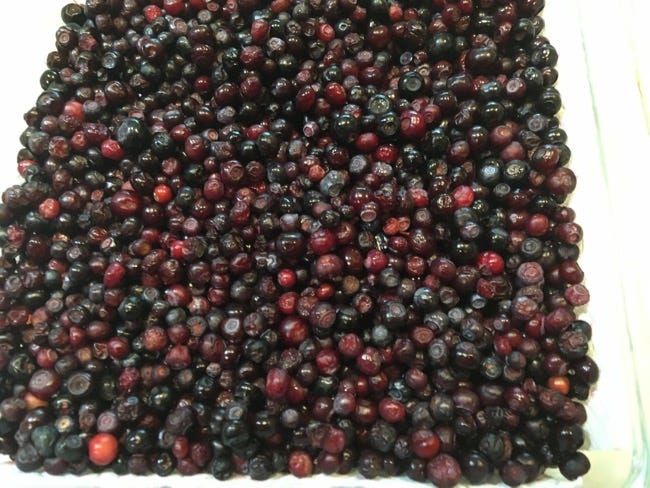
And here are cultivated blueberries.

Blueberries are considerably larger and, while delicious on their own, lack the wild tang of huckleberries. But, blueberries are excellent in this tart. Just follow the recipe for the Blueberry-Lime Variation.
Got questions? Comments? I'd love to hear from you.
Happy Baking!