

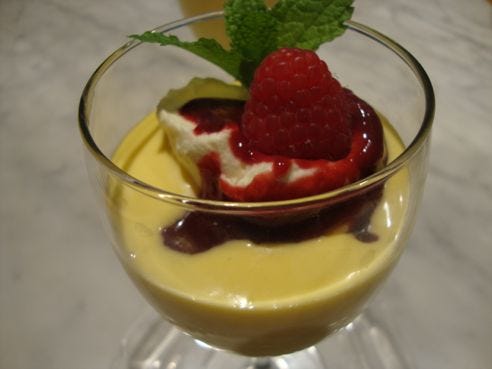
What is Lemon Curd?
What’s in a name? How unfortunate that lemon curd is saddled with its. Curd suggests a texture of cottage cheese, doesn’t it? But lemon curd, made from lemons, sugar, butter, and sugar, is silky smooth and creamy and completely non-curdy. It’s an ideal mate for a crisp piece of toast, English muffin, or scone; a tangy filling for a cookie or tartlet; and a topping on a slice of spice or pound cake. Its uses are endless. It’s great to have on hand in the refrigerator or freezer. And the best part is lemon curd is easy to make.
Two Methods to Make Lemon Curd
There are two different ways to make lemon curd. The most common is to whisk the eggs, sugar, and lemon juice together, add the cold butter cut into small pieces, and stir everything together in a saucepan over a low heat until the butter melts and the whole mass thickens into a custard-like cream. The other way is similar to making a cake. You beat the butter and sugar with an electric mixer until smooth and fluffy, beat in the eggs and juice and slowly cook the brew. Which is best? Making lemon curd involves knowing a few things about egg cookery. The most important is to cook them slowly over a relatively low heat so that they thicken but don’t coagulate. Heat and acid excite molecules—in this case egg proteins—and make them want to interact with each other by coming together and bonding. The trick here is to delay the process so that the proteins don’t move about so quickly that they crash into each other and coagulate—as happens when you fry an egg. One way to slow down the egg protein interactions is by using low to medium heat. Another is by introducing other molecules that get in and mingle with the egg proteins to protect them. Sugar and fat, for example. In the first method for making lemon curd, the eggs are whisked with the sugar and juice, but the butter is added later. In the second method, both sugar and butter are beaten with the eggs, giving them a double layer of protection right from the start. My money’s on method 2. And beating vigorously with a mixer denatures the proteins in the eggs so that they won’t curdle as easily as eggs merely whisked. This picture shows the butter creamed with the sugar. After beating in the eggs, the mixture becomes very smooth.
Lemon Curd Tips
Use a heavy-bottomed saucepan. Stainless steel, enameled iron or anodized aluminum are all excellent. Don’t use plain aluminum because it reacts with acids in lemon, discolors the curd, and gives it a metallic taste. A large pan is better than a small one to give you ample room to stir the curd. Use a heatproof rubber spatula and whisk. I use the spatula for most of the cooking and switch to the whisk near the end just to make sure the curd is smooth. Stir the curd often as it cooks. Make sure to move your spatula or whisk constantly at a moderate speed all over the bottom, sides, and seam of the pan. Keeping the eggy liquid in motion allows you to control the coagulation reaction. You want it to be slow and gentle so that the curd becomes creamy and smooth, not solid. Watch that heat! Make absolutely certain the curd never reaches the boiling point. The curd will set at 170˚F. I highly recommend you have a digital probe thermometer to check the curd temperature. Once the curd has set it will thicken further as it cools. Now you’re ready to begin.