

March 21, 2023
Pavlova: a Decadent Dessert
What is a Pavlova?
According to Alan Davidson in The Oxford Companion to Food, Australians claim that this dessert, a meringue base topped with whipped cream and cut fresh fruits, was created in 1935 by Herbert Sachse, an Australian chef, in honor of the Russian prima ballerina, Anna Pavlova. Pavlova had visited Australia and New Zealand in 1926. The built-up sides of the meringue, to some, suggest the appearance of a tutu. But the actual facts or Pavlova’s origin and name are far from clear. Be that as it may, this is a luscious dessert, and it has rightfully become well-known in many parts of the world.
Where Greg Learned to Make a Where Greg Learned to Make a Pavlova
I learned how to make this from Elizabeth Germaine, a cookbook author and cooking teacher from Melbourne. She made it for special occasions for as long as she can remember in her home country, and she has continued to do so since moving to the United States more than 30 years ago.
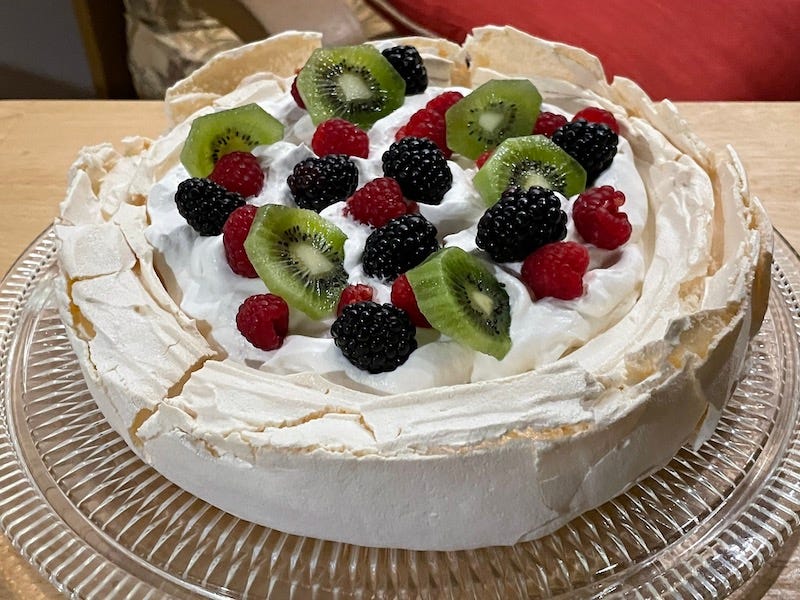
The hallmark of a well-made Pavlova is a crisp meringue exterior with a marshmallow-like interior. “Do not make this on a humid day,” Elizabeth cautions, “It will just not be right.” The traditional fruits for a Pavlova are strawberries, bananas, kiwi, and passion fruit. For the one pictured in this recipe, I used kiwi, raspberries, and blackberries. Passion may be hard to find, or if you can find it it’s liable to be quite pricey, so many bakers leave it out.
For the most voluminous, stiff meringue, make sure your mixing bowl and whip are scrupulously clean and free of grease.
Variation: Passion Fruit Pavlova
Passion fruit, the fruit of a tropical vine, is about the size of a large egg. According to Alan Davidson in The Oxford Companion to Food, it gets its name from Jesuit missionaries, who used the Spanish name of the passion flower–Flor de las cinco lagas—flower of the five wounds–to illustrate the crucifixion of Christ. Each part of the flower has a specific symbology.
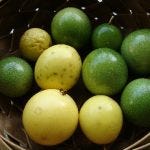
The most common variety of passion fruit, the kind grown in Australia and New Zealand, has a deep purple skin. The rind of the Hawaiian passion fruit is yellow. The soft, orange pulp contains tiny, edible, black seeds, and all of it is used to make Pavlova. is a Pavlova?
This internationally famous dessert is claimed by Australians and New Zealanders as its country’s birthplace. The issue is not settled, and it may never be, but that is not the point. What is the point is that this dessert is a masterpiece of simplicity, beauty, and taste.
The contrast of a crispy meringue “crust” and its inner creaminess unite with the lusciousness of whipped cream and a combination of fruits in a swoon-inducing explosion of texture and flavor.