

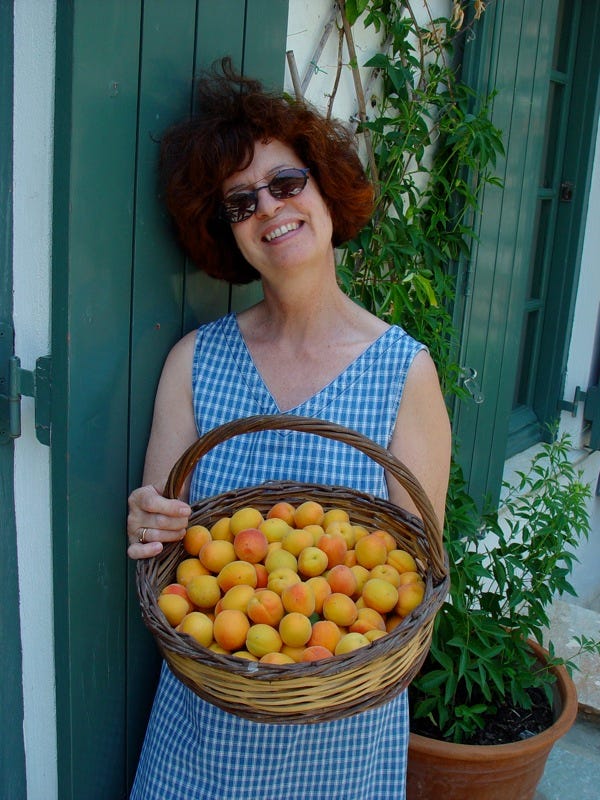
Over the past couple of years, Aglaia and I subscribed to each other’s Substack newsletters and we always exchanged comments. We also recommended each others newsletters to Substack readers. Substack is how we kept in touch. I had met Aglaia in 1995 when we were both on an Oldways road trip in Italy to learn about the foods and culture of Puglia. And what a trip that was! We were bus-mates. What I remember most was trying to have conversations while being jostled along the bumpiest roads we had ever experienced. Of course we laughed a lot.
At the time, I knew that Aglaia had written “The Foods of Greece,” her first English language cookbook published in 1993. I bought it because my wife, Dorothy, had lived in Greece and loved Greek cooking. Aglaia and I chatted about the astonishing variety of Greek cooking and she said that even the cuisine on each Island is very distinctive.
After the Italian trip, I kept track of Aglaia’s cookbooks. She had written six major ones in English, and three of them were on Mediterranean cuisine. We were not in touch, but somehow her joy and openness were always with me.
When her substack posts stopped—the last one I had received was in late February—I got worried. So I googled her and gasped when her photo popped up along with the date of her death: May 19. She was born on May 4. I was born on May 5. Different years, but the days matter.
During the past couple of years, Aglaia and her husband, Costas, have been welcoming visitors to their home and cooking school on the island of Kea. Please visit www.aegeanislandkitchen learn more about the school and what plans are in place for its future.
Aglaia loved cooking vegetables, and two of her favorites, eggplant and zucchini, are also two of mine. In Hawaii, slender Japanese eggplant takes precedence over the globe variety. It cooks very quickly with no advanced salting to remove bitterness because these eggplants are not bitter. They have a background sweetness. Just slice and fry quickly in olive oil. And zucchini are cooked in their juvenile state. I call them baby zucchini. Each one weighs about an ounce.
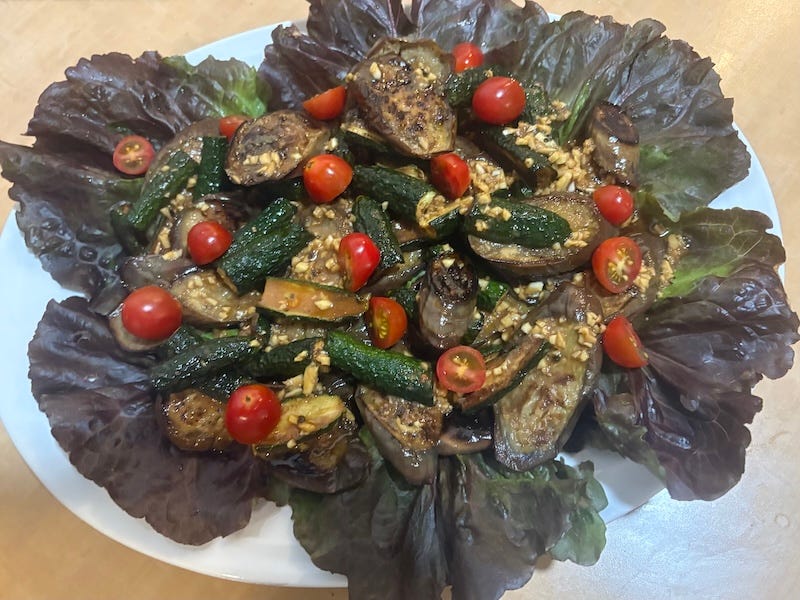
To honor Aglaia, I created this salad of Japanese eggplant and zucchini with a miso rice vinegar dressing. It’s not Greek or even Mediterranean, but I feel that Aglaia would like it. Here’s the recipe. It will make 4 nice servings.
Japanese Eggplant and Zucchini Salad with Miso Rice Vinegar Dressing
3 medium Japanese eggplants, about 1 pound total
1/2 pound baby zucchini, about 8 ounces total
Extra-virgin olive oil, as needed, for frying
Salt and pepper
Cherry tomatoes, 10 or so, halved through the stem
Lettuce leaves to line serving platter
The Dressing:
1 tablespoon white miso
1 tablespoon soy sauce
2 to 3 tablespoons unseasoned rice vinegar
1 tablespoon extra-virgin olive oil
2 teaspoons toasted sesame oil
1 tablespoon honey
1 tablespoon finely chopped ginger, peeled or not
2 garlic cloves, finely chopped
1/4 cup chopped Italian parsley leaves
Cut the stems off the eggplant at an angle and slice the eggplant at an angle into 1/2-inch-thick slices (just approximate the thickness).
In a large nonstick skillet, heat 2 tablespoons of the olive oil over medium high. When the oil is hot, layer in the eggplant. All of it may not fit. Cook until both sides are nicely browned, 3 to 4 minutes total. Salt and pepper lightly and set aside. Repeat with remaining eggplant, adding more oil as necessary.
Cut the zucchini in half lengthwise, then in half crosswise. If only regular zucchini is available, slice 8 ounces crosswise about 1/4-inch-thick. Cook as you did the eggplant. Set aside on a plate and salt and pepper lightly.
Prep the cherry tomatoes. Line a serving platter with lettuce leaves.
For the dressing, put the miso, soy, and 2 tablespoons of the rice vinegar into a medium bowl and whisk until smooth. Whisk in the olive oil, toasted sesame oil, honey, ginger, and garlic. Taste. If you feel the dressing needs more tartness, drizzle in up to 1 more tablespoon of rice vinegar. Whisk in the parsley.
To serve, arrange lettuce leaves to cover the surface of the serving platter. Top with the eggplant, zucchini, and tomatoes. Whisk the dressing one final time and drizzle it evenly over the eggplant, zucchini, and tomatoes. Serve on salad plates. Leftover salad keeps well in the fridge for 2 or 3 days.
Hi Greg,
I too was so surprised to learn that she had died. I read the mournful newsletter from her husband, but before that, tributes from Jose Andres and Corby Kummer.
We only met once, at the Oxford Food Symposium, and I didn't know who she was. Later I enjoyed her newsletters. She had a ton of energy and enthusiasm, according to Andres.
Why a beautiful salad! Fried eggplant always reminds me of my mother's Iraqi version: salted and fried until almost black, eaten on a slice of bread with the oil dripping into it. Heavenly!
BTW, when I tried to comment, I had to put in a code that arrived in my email. Did you know about this?
After our discussion about Japanese eggplant, I did some searching and calling.
Interesting findings:
1. People are posting photos of Chinese eggplant, which are lighter in color, and calling them Japanese eggplant. I found this when I searched for Images of Japanese eggplant. It's not just AI that gets it wrong.
2. The Good Food Store does not carry Japanese eggplant. The produce guy said that this was the first time he had heard of them; so, it seems that education is part of your post! And, he kindly suggested I call Natural Grocers, which I thought was very collaborative of them.
3. The grocery guy at Natural Grocers knew of Japanese eggplant. He said that they have carried them before, but they have to buy 30 lbs, and they are unfamiliar to the Missoula market. Again, your post is an education!
And, thanks to your introducing me to the work of Aglaia, I ordered one of her cookbooks for my collection.